English


Views: 0 Author: Site Editor Publish Time: 2026-11-22 Origin: Site
Video transmission loss is never just a minor inconvenience. For commercial drone operators and high-end FPV pilots, a dropped signal often means compromised data, aborted missions, or even total asset loss in challenging environments. We must look beyond basic radio control to understand the Drone Data Link. It serves as the critical bridge connecting your aircraft directly to the ground station. This link handles complex video and telemetry streams simultaneously. Without a robust connection, even the most advanced payload becomes entirely useless.
In this article, we strip away misleading marketing claims regarding theoretical maximum ranges. You will discover an objective framework for evaluating hardware constraints, environmental realities, and overall signal reliability. By the end, you will know exactly how to assess your specific operational environment. We will guide you on optimizing your setup for consistent, real-world performance.
A drone data link's effective range is dictated by a strict compromise between frequency, bandwidth, and transmission power, not just the manufacturer's spec sheet.
Digital (HD) and Analog systems fail differently; choosing between them depends on whether your operation prioritizes zero-latency graceful degradation or high-resolution clarity.
Environmental interference and physical obstacles (RF noise, foliage, concrete) will throttle transmission quality long before battery life runs out.
Regulatory compliance (FCC vs. CE modes) strictly limits out-of-the-box transmission power (VTX), requiring operators to match their hardware to regional legal frameworks.
Pilots often underestimate the true cost of signal degradation. In commercial environments, a compromised video feed translates directly into financial losses. Consider a complex bridge inspection. If high latency delays your visual feedback, you might crash an expensive asset into a concrete pillar. In topographic surveying, low-resolution feeds obscure crucial visual markers. You might miss critical data points entirely. You then have to spend hours re-flying the mission.
A successful equipment evaluation requires a shift in mindset. You must prioritize consistent bitrates at operational ranges over theoretical peak distances. Manufacturers often advertise ranges up to fifteen kilometers. However, they test these metrics under perfect, interference-free conditions. In reality, you need absolute reliability at one or two kilometers. A stable, high-bitrate connection at close range matters far more than a spotty connection at extreme distances.
We also have to assess the physical risks associated with signal failure. Operators face a phenomenon known as the "digital cliff." When flying an HD digital system, your picture remains crystal clear right up until it suddenly vanishes. You get very little warning before total signal loss. Conversely, analog systems exhibit a gradual build-up of static. The picture gets progressively worse, giving you ample time to turn the aircraft around. Understanding this operational difference dictates how aggressively you can fly near physical obstacles.
Your transmission range depends on basic physics. Several core variables interact to determine exactly how far and how clearly you can transmit video.
Every pilot must choose the right frequency for the mission. The 2.4 GHz and 5.8 GHz bands dominate the consumer and enterprise markets. They offer massive bandwidth. This allows them to carry high-definition video feeds seamlessly. Unfortunately, they suffer from poor penetration. High-frequency waves cannot pass easily through solid objects like concrete, steel, or dense foliage. If you fly behind a thick tree line, your 5.8 GHz video feed will likely drop.
Alternatively, the 900 MHz (Sub-GHz) band offers superior penetration. It punches through obstacles and achieves incredible range. However, this lower frequency provides highly limited bandwidth. You generally restrict 900 MHz systems to telemetry and basic control rather than high-quality video.
Frequency Band Comparison Chart
Frequency Band | Bandwidth Capacity | Obstacle Penetration | Primary Use Case |
|---|---|---|---|
5.8 GHz | Very High | Poor | HD Video, Short-to-Mid Range |
2.4 GHz | High | Moderate | Video and Control, Mid Range |
900 MHz | Low | Excellent | Telemetry, Long Range Control |
Many pilots misunderstand video transmitter (VTX) power. They assume they can double their range by doubling their milliwatt (mW) output. This relationship is entirely non-linear. Increasing your output from 400mW to 800mW will not double your flight distance. It merely pushes the signal slightly harder through minor interference. You gain marginal penetration capabilities at the cost of significantly higher battery drain and dangerous heat generation.
Direct line of sight is not just about drawing a straight line between the remote and the aircraft. You must account for the Fresnel zone. Think of the radio frequency path as a three-dimensional, football-shaped area. Objects sitting outside your direct visual path can still enter this zone. When ground clutter, cars, or trees intrude into the Fresnel zone, they scatter and degrade the RF signal. You might see the drone perfectly, but your Drone Data Link will still suffer from interference.
Your operating environment plays a massive role in signal clarity. Flying in high-interference urban environments presents unique challenges. Cities are flooded with Wi-Fi routers, cell towers, and Bluetooth devices. These all compete on the congested 2.4 and 5.8GHz bands. Your receiver struggles to hear the drone over this background noise. In contrast, rural areas offer a much lower noise floor. The same hardware configuration will yield vastly superior range in an empty field compared to a downtown construction site.
Modern operators essentially choose between two primary architectures for video transmission. Each solution category offers distinct advantages and caters to entirely different mission profiles.
Traditional analog transmission remains highly relevant in specific sectors. It relies on standard radio frequencies to send an uncompressed video signal.
Pros: Analog provides near-zero latency. The hardware is significantly cheaper and much lighter. Crucially, the signal degrades predictably. As you fly further away, static slowly obscures the image. This gives pilots plenty of time to react and adjust their heading.
Cons: The resolution is undeniably low. It looks akin to an old VHS tape. Analog feeds are also highly susceptible to multi-path interference. When radio waves bounce off concrete walls, they arrive at the receiver at slightly different times. This creates severe visual ghosting and tearing.
Digital systems encode the video into data packets before transmission. This technology has revolutionized commercial drone operations.
Pros: Digital offers exceptional visual clarity. You can spot hairline cracks on a pipeline from fifty feet away. This resolution is absolutely critical for detailed industrial inspections and cinematic flying.
Cons: Digital encoding introduces higher latency. The hardware runs hotter, costs more, and weighs more. The biggest drawback is sudden signal loss. When packets fail to arrive, the screen simply freezes or goes black without warning.
You must match the technology directly to your desired outcome. If you fly high-speed proximity missions or competitive racing, choose analog. The zero latency and gradual degradation keep you safe. If you conduct surveying, real estate photography, or cinema work, you need digital HD. The high resolution guarantees you capture the required visual data.
Even the most powerful video transmitter fails if paired with inadequate antennas. Many operators experience range issues simply because they misunderstand antenna architecture.
Consumer drones often ship with stock omnidirectional antennas. These antennas radiate the signal in a massive, donut-shaped pattern. They spray energy in all directions simultaneously. This works perfectly for flying close to yourself. However, this broad radiation pattern wastes energy when you try to fly far away. Stock antennas fail at long range because they do not focus the transmission power.
To achieve reliable long-range video, you must evaluate your ground-station antennas. You should upgrade to high-gain directional patch antennas for distance flying. A directional antenna focuses the radio waves into a narrow, concentrated beam. It acts like a flashlight rather than a lantern. You must keep the directional antenna pointed exactly at the aircraft. When configured correctly, this upgrade drastically extends your operational radius.
Antenna polarization dictates how the radio waves spin as they travel through the air. You generally use Circularly Polarized antennas for video transmission. These come in two types: Left-Hand Circular Polarization (LHCP) and Right-Hand Circular Polarization (RHCP). You must verify polarization matching across your entire system. The drone and the goggles must use the exact same type. If you mix an LHCP antenna with an RHCP antenna, you will experience immediate and catastrophic signal degradation. This simple oversight is a highly common implementation failure among new operators.
Legal restrictions dictate hardware performance more strictly than physics in many regions. You must adopt compliance-aware thinking before planning long-range missions.
Aperture, frequency, and transmission power fall under intense government regulation globally. Your video transmitter cannot legally output its maximum capability out of the box in certain countries. You must understand the specific radio laws governing your operational area.
We see a massive performance disparity between global regions. In the United States, the Federal Communications Commission (FCC) allows much higher power output. Operators can often legally push their systems to 1000mW or more on certain frequencies. In Europe, the Conformité Européenne (CE) standards strictly limit the 5.8GHz band to a mere 25mW. A system operating at 25mW will struggle to penetrate even a single dense line of trees.
Many operators attempt to bypass these restrictions. They use software "hacks" or custom firmware to unlock FCC mode while flying in CE regions. This practice carries severe implementation risks. Modifying transmission power illegally violates local broadcasting laws. Furthermore, it impacts enterprise liability. If you crash a drone while operating an illegal radio transmitter, your insurance provider will likely deny the claim. Commercial entities cannot afford to take these regulatory risks.
You can drastically improve your transmission quality without buying new hardware. Adopting proper operational protocols eliminates many common interference issues.
Pre-Flight RF Scanning: Never power up and launch blindly. Use the built-in spectrum analyzers found in most modern digital goggles. Scan the local environment for active frequencies. Identify congested channels and manually select a clean frequency before takeoff. This simple habit prevents mid-air dropouts.
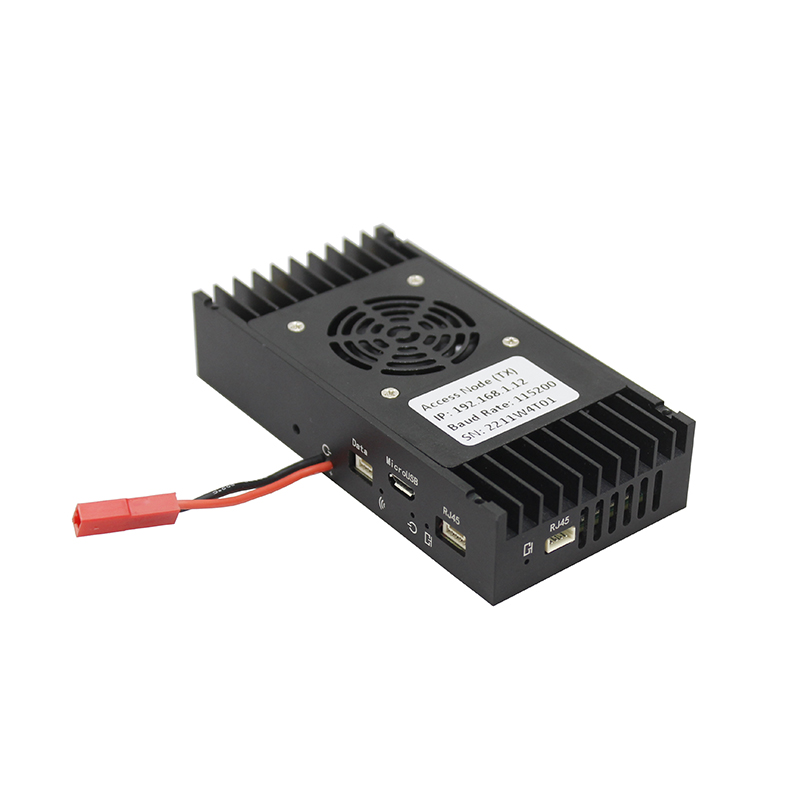
Thermal Management: High-power VTX units generate extreme heat. They require continuous airflow to remain cool. Many pilots perform lengthy stationary tests on the ground. Without the wind from the propellers, the VTX rapidly overheats. It will automatically induce thermal throttling. This artificially reduces your transmission quality and power before the drone even leaves the ground. Keep ground testing brief.
Strategic Positioning: Your physical location dictates your maximum range. Standing on flat ground limits your line of sight. The earth itself absorbs radio frequencies. Elevating the pilot or the ground station by just a few meters drastically improves performance. Stand on a small hill, the bed of a truck, or an elevated platform. Clearing ground-level RF absorption pushes your signal much further.
Evaluating your video transmission system requires a calculated approach. You must select hardware based on your specific environment and regional compliance limits. Determine whether your mission demands the low latency of analog or the high resolution of digital HD. Every choice involves a strict compromise between bandwidth, range, and legal power constraints.
We advise buyers to completely ignore "maximum range" marketing metrics. Instead, test your equipment under real-world interference loads. Focus on maintaining a stable bitrate in challenging environments rather than pushing for theoretical distance records. A reliable short-range signal holds far more value than a fragile long-range connection.
Before purchasing an expensive enterprise data link system, audit your current payload requirements. If you struggle with signal stability, consult with a professional integration specialist. They can help you configure your antennas and frequencies to match your exact operational needs.
A: Yes, weather significantly impacts radio signals. High humidity, dense fog, and heavy rain physically absorb high-frequency RF signals, especially on the 5.8GHz band. Water particles scatter the radio waves, severely reducing your effective video range and degrading overall image quality.
A: It depends on the system architecture. Traditional analog video is entirely unencrypted. Anyone with an analog receiver on the same frequency can view your feed. Modern digital HD systems often incorporate proprietary encoding or AES digital encryption, making them vastly more secure for enterprise operations.
A: Close-range lag usually stems from environmental factors rather than distance. It is often caused by severe channel congestion in urban areas. Mismatched antennas or incorrect polarization also degrade nearby signals. Finally, if you lingered on the ground too long before takeoff, your VTX may be experiencing thermal throttling.